
Blue Band Raw Hair (Premium Quality) Wholesale What the Band Actually Certifies

Every grading system in this trade is informal, which is why the ones that carry a physical mark are worth understanding. A coloured band on a bundle is not decoration and it is not a brand; it is a sorting decision made at the point where the hair was graded, and in the raw programme it identifies which tier of a narrow supply the bundle came from. That is a modest claim and a useful one, because it is the only claim in the category that is attached to an object rather than to a sentence. What the band certifies, and what it does not, is the difference between a specification a buyer can hold in their hand and a word on a page that any competitor can print.
The Band Is a Sorting Decision
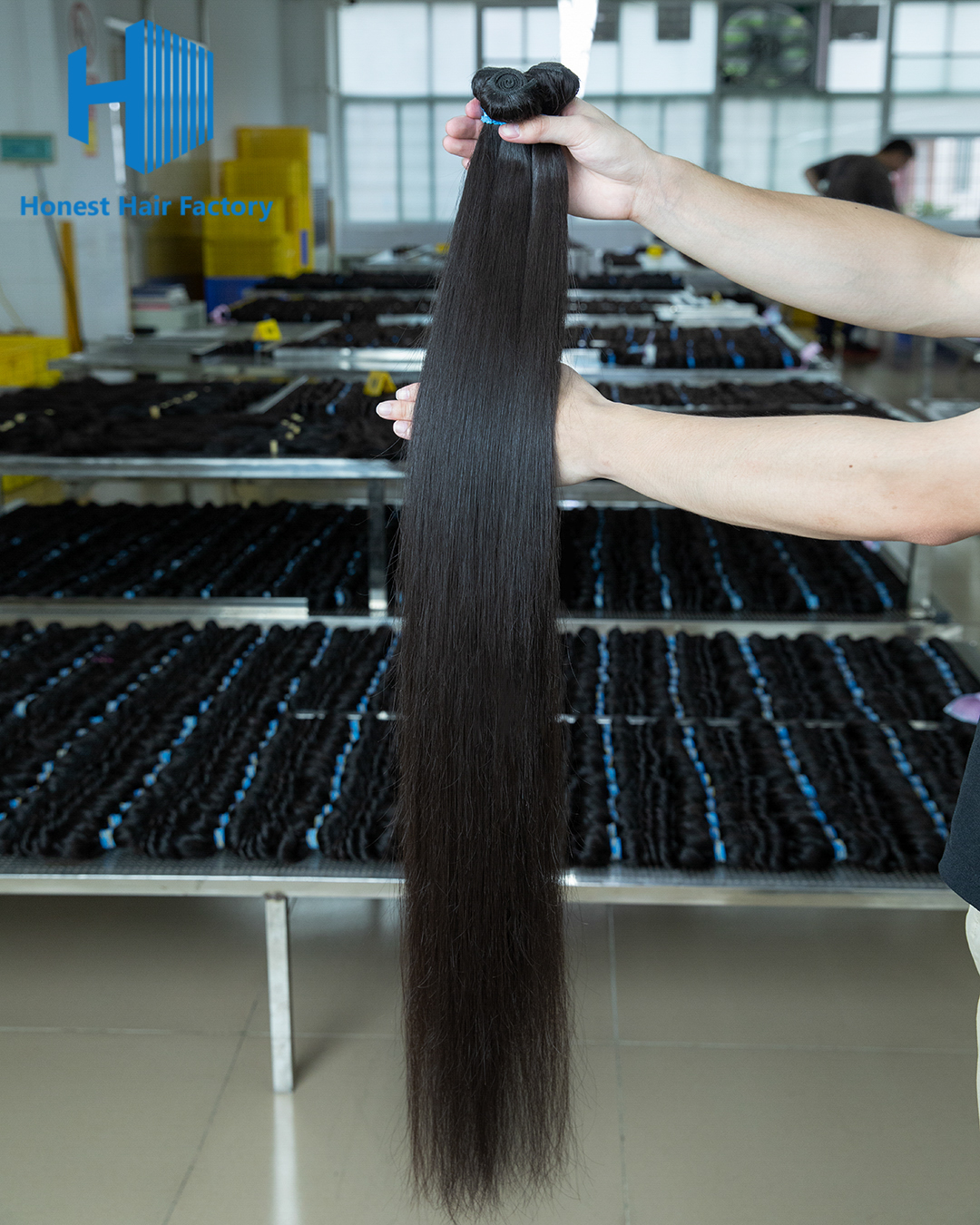
Raw hair arrives at a factory in mixed form and has to be separated before it can be sold. The separation runs along four axes at once: length, strand thickness, natural pattern, and how much of the bundle reaches the full length. A senior sorter makes those decisions by hand and by eye, and the output is a set of tiers that differ in ways a photograph cannot show. The band is the label attached to the tier, and its function is to let a buyer reorder the same tier rather than a description of it, which is the only thing that makes a repeat purchase predictable.This is why the band matters more in raw hair than in processed hair. A processed bundle has been steamed, aligned, and often dyed, and those steps flatten the natural variation to the point where two tiers look similar. A raw bundle keeps whatever the donor’s hair did, so the tier is the product. Two bundles with the same band should behave the same way after ten washes. Two bundles without a band are two bundles, and the buyer is relying on memory. There is a second reason the band matters, which is that it makes a complaint resolvable. When a buyer says the reorder does not match, the first question is whether both bundles carry the same band. If they do, the difference is a sorting failure within a tier and the factory owns it. If they do not, the buyer has been moved between tiers without being told, which is a commercial failure rather than a production one, and the remedy is different. Without the band, that conversation has no starting point and usually ends in a discount that satisfies nobody.
What the Band Certifies
It certifies that the bundle was sorted into a defined tier by a person qualified to do so, and that the tier was recorded. That is the whole claim, and it is enough to be useful. It means the bundle is not a blend of tiers assembled to hit a price, which is the most common form of substitution in this market and the hardest to detect, because a blend looks correct on the day and separates over time as the different tiers age at different rates. A banded bundle is a promise that the contents came from one tier rather than from whatever was left at the end of a sorting run.It also certifies, indirectly, that someone handled the bundle after sorting rather than before. A band applied at packing is a band applied to a bundle whose contents are already fixed, and a band applied earlier is a band applied to a bundle that could still be topped up. The difference is not visible from outside, which is why the useful question is not what the band means but when it was applied and by whom. A supplier who can answer that has a process. A supplier who cannot has a sticker.
What the Band Does Not Certify
It does not certify that the hair is from a single donor, although the top tiers usually are. It does not certify a country of origin, because raw material moves between collection regions before it reaches a factory and the paperwork rarely follows it precisely. It does not certify that the bundle will not shed, because shedding is a function of the weft rather than of the hair. And it does not certify a colour result, because raw hair has not been coloured and its behaviour under a lift is a property of the material rather than of the tier.Those four exclusions are worth holding in mind because each of them is regularly implied by sellers who are otherwise accurate about the band. The band is a statement about sorting, and sorting is one dimension of a product that has at least six. A buyer who treats it as a summary will be disappointed in a way that feels like deception and is really a category error, and the seller will be genuinely puzzled by the complaint because the claim was never made. It is worth adding a fifth exclusion, which is the one buyers ask about most. The band does not certify that the bundle is bleach-ready. Raw hair lifts well in general because the cuticle is intact, but the tolerance for a lift depends on the strand and on the number of passes, and a top-tier bundle can still fail at 613 if the lift is pushed in a single session. Tier describes the sorting, not the chemistry.
The Specification Behind the Band
The table below sets out what a banded raw bundle should be measurable against, in the order a buyer can actually check it. None of these measurements requires equipment beyond a tape and a scale, and all of them are more informative than the band itself, which is why the band should be treated as an index into the specification rather than as a substitute for it.
| Attribute | Expected at the top tier | How to check |
|---|---|---|
| Weight | 105 g, tie excluded | Scale, ten bundles |
| Length distribution | Most strands reach the tip | Fan against a ruler |
| Cuticle direction | Smooth one way, rough the other | Thumb and forefinger test |
| Pattern retention | Unchanged after washing | Wash and dry flat |
| Strand variation | Gradual, not abrupt | Spread and inspect |
| Weft | Stated construction, no hard spots | Run a thumb along the seam |
The fourth row is the one that separates raw hair from everything else, and it is the easiest to test. A raw bundle that has never been steamed returns to its own pattern after washing, because the pattern is a property of the fibre rather than of a process. A bundle that has been steamed into a pattern reverts to something flatter or straighter, and the change is visible in a single wash. If the pattern survives, the raw claim is credible. If it does not, the band is describing a processed bundle.
The Sourcing Constraint
Raw hair is expensive for a reason that has nothing to do with processing and everything to do with supply. A single donor produces a limited quantity of hair in a limited range of lengths, and the proportion that reaches thirty inches is small. To assemble a bundle of thirty-inch raw hair, a factory must collect from many donors and sort out the strands that qualify, which means the yield is low and the labour is high. This is why the raw programme is narrow at the long end and why a supplier who claims unlimited availability of thirty-inch raw hair in any texture is describing a warehouse rather than a supply chain.The practical consequence is that raw hair should be bought on a schedule rather than on demand. A buyer who needs a consistent raw line should reserve stock against a forward commitment, because the alternative is to take whatever the sorting produced that month and to rebuild the range around it. Suppliers who understand their own supply will offer this before being asked. Suppliers who do not will accept the order and deliver something adjacent to it, and the gap will appear in the second shipment.
The Seven Textures
A raw programme typically offers several natural patterns, and the number is a function of how many collection regions the factory buys from rather than of how many products it wants to sell. Straight, body wave, deep wave, loose wave, water wave, kinky straight and kinky curly cover most of the range, and the differences between them are differences in the natural coil rather than in processing. That is why two textures from the same programme can sit at the same price, while the same two textures in a processed line can differ, because the processed line has to create the pattern and the cost of creating it varies.
For a buyer, the useful discipline is to order one texture deeply rather than seven textures shallowly. A deep order allows the factory to reserve a lot and hold it, which is the only way to get consistency across a season. Seven shallow orders force the factory to draw from whatever is available, which is the fastest route to the second-order problem. The temptation to offer a wide range is strong and it is usually a mistake at the wholesale level, where the customer is buying repeatability rather than variety.
How to Verify a Band Claim
Three steps, none of which requires trusting the supplier. First, ask for the band to be photographed on the bag with the lot reference visible, so the tier and the lot are linked in a single image. Second, order two bundles from the same band at different times and compare them after washing, because consistency across time is the only proof that the tier is real rather than a label applied to whatever was on the bench. Third, ask what happens if a reorder cannot be filled from the same tier, and listen for whether the answer describes a policy or an apology.
The answers to those three questions tell you more than any certificate, because they describe a process rather than a product. A factory that can band, record, and re-supply a tier has a system. A factory that can band but not re-supply has a habit. The difference shows up in month four, when the first reorder arrives and the customer compares it with what they bought before. For buyers building a raw line, the hair bundles factory range is the natural comparison point because the processed and raw programmes sit side by side, and the 50 inch human hair bundles tier is where the sourcing constraint becomes visible in the price rather than in a conversation.

 The band is worth taking seriously precisely because it is a small, physical, checkable thing in a category full of large, verbal, uncheckable ones. It will not tell you whether the bundle will shed, and it will not tell you what happens under a lift to 613. It will tell you that somebody sorted this and wrote down what they decided, and in a market where most claims are made after the fact, a decision recorded before it is a rare and useful form of evidence.